
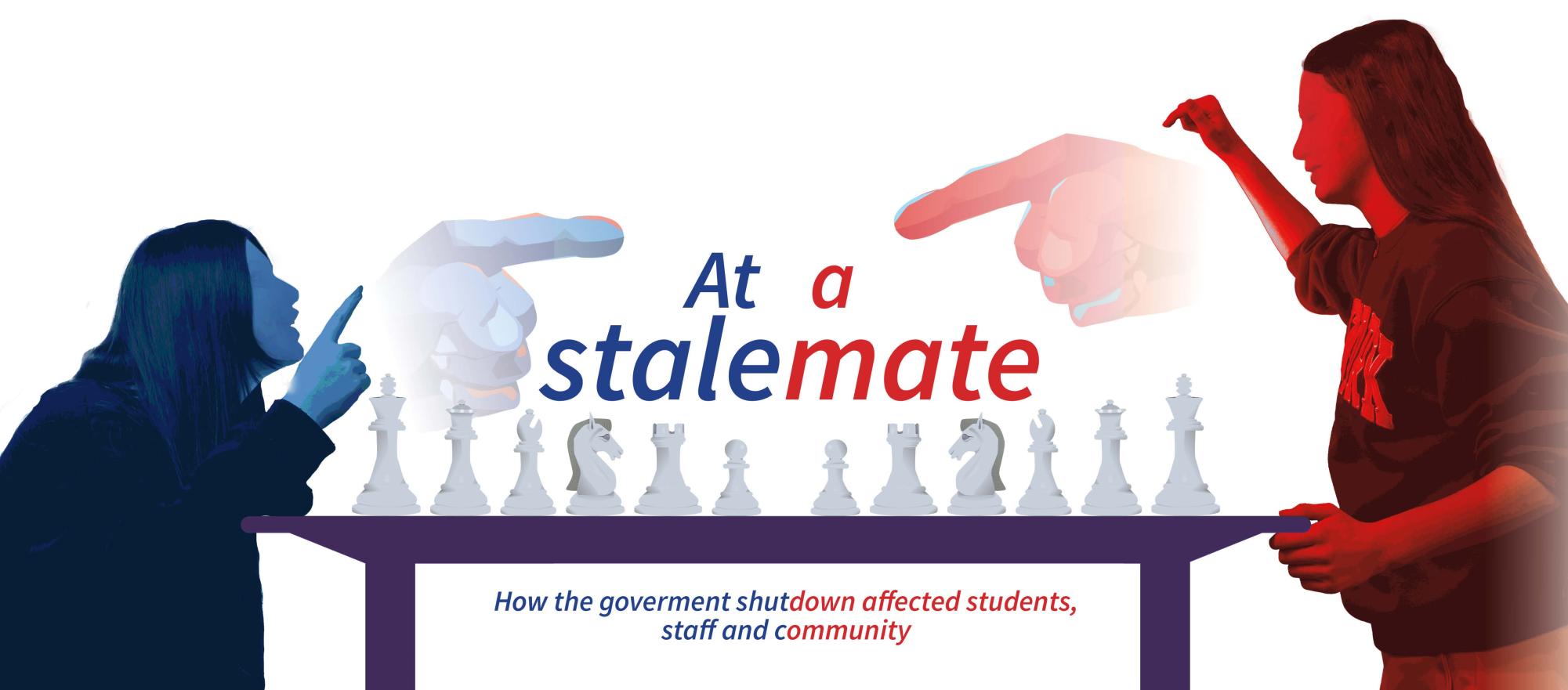



While politicians took their time disputing the federal budget in Congress 600 miles away, ELHS social worker Jasmine Salmon sat down with another anxious student.
But instead of worries regarding test scores, friendship breakups or college applications, the student’s fear was not having a meal on the table.
When the government shutdown began on Oct. 1, all federal funds were frozen, including those directed towards the Supplemental Nutrition Assistance Program (SNAP). SNAP provides monthly financial assistance to low-income families and individuals so they can afford basic groceries. The stalemate disrupted the flow of aid to 42 million families who receive SNAP benefits. Since the shutdown, Salmon has noticed a substantial increase in students struggling to meet basic needs.
“Families that have a lot of children and depend on Department of Health and Human Services assistance for child care or food stamps have been the biggest ones that have come up in conversation with students,” Salmon said. “I’ve had kids who’ve been concerned about their families not having enough to eat and not knowing where their groceries were going to come from.”
Salmon is working with students’ families to provide the resources they need, whether that be from the school or the community. But despite her best efforts, it’s impossible to fix everything.
“There’s a lot more hunger and food insecurity than people realize,” Salmon said. “I work with a lot of parents to help them get access to any state agencies or funding. My goal is to bridge some of the gaps to get those basic needs taken care of, whether that be food, water or having a safe place to lay your head at night.”
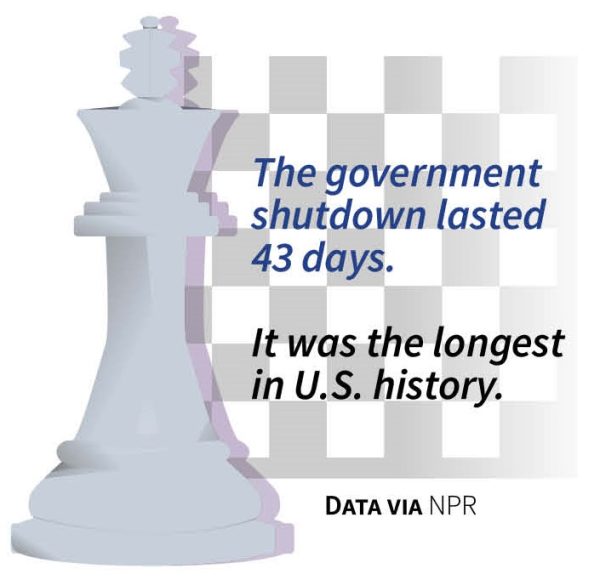
Along with those who rely on government assistance programs, federal employees also faced struggles during the shutdown. Crucial workers like air traffic controllers, prison officers, certain medical providers and the National Guard all went unpaid. Rachel Hunt’s (12) mother, who works for the Food and Drug Administration, was furloughed for 43 days.
“It’s really frustrating that we can go a month shutting our government down and not paying a bunch of essential workers,” Hunt said. “Even what my mom does–it might not seem essential at first, but she’s working on making sure foodborne outbreaks don’t happen. This long of a shutdown is going to have unforeseen effects we don’t even know yet.”
Science teacher Will Paddock’s wife is the Deputy Field Supervisor for the US Fish and Wildlife Service. When the shutdown started, she, too, was without pay or work. Although the family was lucky enough to have two sources of income, the uncertainty of the situation constantly weighed on them.
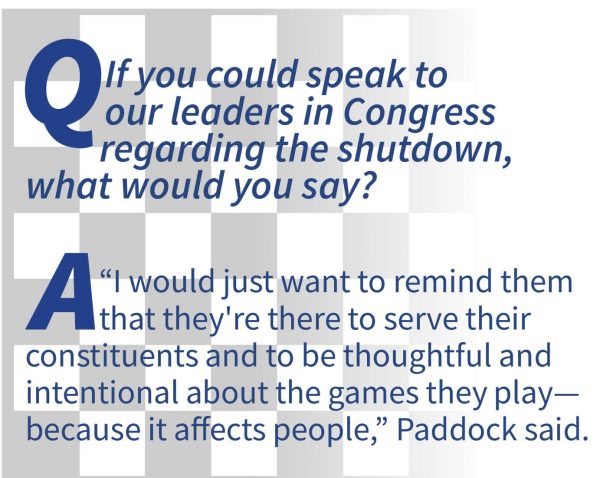
“The biggest thing we faced is the mental, emotional toll of not knowing what would happen,” Paddock said. “But other families, it’s really tough. Going 43 days without a paycheck if you’re the only source of income in the family, that’s super stressful and scary.”
Hunt and Paddock are part of the small percentage of affected families who could afford the financial hardship of the shutdown.
According to Prosperity Now, 40 percent of Americans were one missed paycheck away from poverty in 2019. Since then, poverty rates have only risen. So when the government shutdown caused over 1.4 million workers to miss two paychecks, the results on most families were detrimental. Per the Georgia Center for Opportunity, an additional 3 million Americans are predicted to fall into poverty by the end of 2025 due to the shutdown.
“It seems like an attempt for one side or another to try to get something that the other side doesn’t want to give,” Paddock said. “And I know that happens a lot in politics. But when you do it with a shutdown, it affects all these people who care a lot about what they do and are doing good work that supports all of us. It’s frustrating to see them get used as a political pawn.”
During the 43 days the government was shut down, over 15,000 airport workers were without pay. As a result, tens of thousands of flights were delayed and canceled, causing major disruptions during a season when traveling is common. Student Evelyn Laxton (11) experienced this first-hand.
“We were about to leave for the airport, and that’s when the flight got canceled,” Laxton said.
Laxton and her mom had known about the possibility of canceled flights, and were already planning what they would do if their flight was canceled.
“Since it was important to see my family and be at my cousin’s baby shower, we decided to drive,” Laxton said.
Laxton and her mom ended up having to drive nine plus hours, as well as leave a day early just to make it in time. Throughout the drive both there and back, they experienced many rough storms, specifically through the Pennsylvania turnpike, which is a series of tunnels that go through the Appalachian mountains.
“I was scared we were going to hit a deer,” Laxton said. “It was so dark, and the roads were really isolated.”
Their initial plan after the canceled flight was for her and her mom to take turns driving.
“It was just me and my mom, and since she didn’t really trust me driving in the storm at night, she ended up driving the whole way,” Laxton said.
They had planned to stay later on Sunday but could not get a flight back to Lansing due to delays and cancellations.
“We had to leave early on Sunday to drive back, so we didn’t get to stay and see everyone as long as we wanted,” Laxton said.
What was supposed to be a quick trip for an important family event turned into a very rushed and stressful journey.
While Laxton personally experienced rough travel, the Lansing airport worked hard to minimize the effects of this occurring for their patrons. According to Katherine Japinga, the Director of Marketing at the Capital Region International Airport (LAN), federal employees continued to work without pay during the shut down. LAN has approximately 55 federal employees consisting of TSA agents and air traffic control tower staff.
“We are very grateful to have such dedicated employees supporting the Lansing airport,” Japinga said.
Even though workers continued to work through the shutdown, it was not without financial impacts. The community came together where they could.
“The airport staff worked with local businesses for lunch donations to support all of the federal workers at LAN,” Japinga said. “We also set up a way for people to donate online via the airport’s website and those funds were used to provide lunches or gas gift cards to the employees.”
Although Laxton experienced travel disruptions, the Lansing airport saw fewer flight delays and cancellations compared to larger airports, and operations returned to normal quickly after the shutdown.
“We are ready to support our federal staff for a busy December travel season and are expecting things to continue running smoothly,” Japinga said. “Our job as the airport staff is to make sure that our facilities are ready to support the airlines and their operations.”
When the United States federal government shut down on Oct. 1, there was much uncertainty in the district. With government programs like the SNAP suspended and wages for federal employees lost, some struggled. Knowing that East Lansing families would be affected, central administration, including Assistant Superintendent Mark Dobson felt an obligation to organize something. They put together Thanksgiving Week Survival Kits: food bags containing breakfast, lunch and snacks for families over Thanksgiving break.
“We have some weekend programs, but for that week, we were especially concerned.” Dobson said. “That’s [when] we started to gather and distribute around the district.”
But they weren’t the only ones working to help during this time of need.
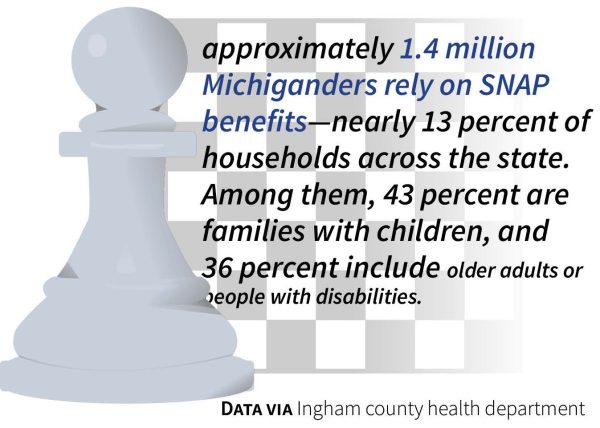
From student services staff to clubs like National Honor Society (NHS) and Key Club to organizations like Haven House, many stepped up to ensure East Lansing families were supported during the shutdown. Resources offered within the school include the Trojan Threads program run by student services administrative assistant Kristen Pfaendtner, the Weekend Survival Kits program administered by social worker Kristin Sesti and more.
An essential part in offering these services was Pfaendtner, who receives calls from families in need of assistance. She noticed an uptick in these due to the shutdown.
One of Pfaendtner’s main ways of helping families was with a list of resources in the area from Haven House.
“It has resources [for] if you need clothing, food, help paying your bills, your rent, your utilities,” Pfaendtner said.
This year, the school schedule was tweaked, leaving an entire week off for Thanksgiving opposed to the usual three days. The government was still shut down at the start of November, which sparked worry about families who rely on free school meals struggling during the extended break.
Members of the district came together to create the Thanksgiving Week Survival Kits to help out during this time. These people included both
Dobson and Superintendent Dori Leyko, along with administrative assistant to superintendent and board of education Kelly Hocquard, Director of Equity and Social Justice Klaudia Burton and more. While the government did reach an agreement on Nov. 12, the kits were still distributed the week before break.

Another resource for East Lansing families around Thanksgiving was the yearly Turkey Drive, run by NHS. Last year, the club was behind on their goal, so the pressure was on this year to really make a difference, especially with the impacts of the government shutdown. NHS director Sheri Seyka felt this increased demand.
“There’s a bigger need this year, and so we have been really trying to push it,” Seyka said.
Key Club members, such as vice president Clara Keith (11), thought that supporting the Turkey Drive would be a great way to help the community and they asked NHS if they could help out. The clubs came up with the idea to hand out Tootsie Pops with little notes attached, reminding students to donate for the Turkey Drive.
“We thought that if it was attached to candy, people would pay attention and want to get it,” Keith said.
During the shutdown, many people emerged to do their part in the community, highlighting how help for those who need it will always be available at the school.
“Our community is rich with resources and programs to help support anyone in any basic need or emotional need,” Sesti said. “If there’s something that you need, reach out.”
It was a game of numbers.
On Oct. 1, seven of Michigan’s 13 U.S. representatives voted yes on a bill that would end SNAP benefits utilized by 42 million Americans nationwide.
One of these seven votes was cast by East Lansing’s representative, Tom Barrett.
Thirty days later, those funds were set to freeze.
So on that same day, a man stood outside Barrett’s office, located directly across from the capitol. Waiting.
He would stay there for another 30 hours.
Surrounding him were boxes and bags filled with food. Folding chairs littered the space, strewn with discarded coffee cups and unneeded clothing layers. At his feet, a cardboard sign proclaimed “Tom Barrett would rather take food from the hungry than give care to the sick” in bold letters.
That man was ELHS alum William Lawrence (‘08), who’s campaigning to replace Barrett as the U.S. Representative for Michigan’s 7th Congressional District in the 2026 election.
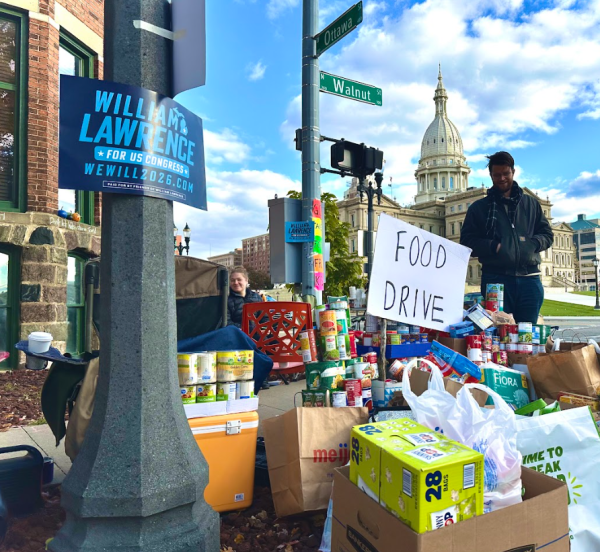
“That [message] was very, very clear,” Lawrence said. “I don’t think people are going to forget that.” In those 30 hours, Lawrence raised over 1,000 pounds of food and $1,300 to donate to the Greater Lansing Food Bank in service of his lifelong community.
“The fact of the matter is the president and his party retaliated by depriving people of their food,” Lawrence said. “We have to be prepared as a community and as a people [to] withstand that rather than folding under the pressure.”
While these SNAP benefits were restored in the bill that reopened the government on Nov. 12, Democrats were forced to concede one of their other main goals in the negotiations: extended subsidies on the Affordable Care Act (ACA).
These subsidies reduce the cost of healthcare, making it easier for lower income families to access necessary health assistance.
For Lawrence, this was a brutal loss.
“I’m deeply concerned for the suffering that’s going to happen when people get pushed off their care and when their premiums increase by two or three times,” Lawrence said.
Lawrence isn’t alone in his frustrations. Brian Beverly, Director of K-12 Outreach at Michigan State University, believes that the lack of these tax credits will only add to the burden felt by everyday citizens.
“A deal that doesn’t protect health care reimbursements is going to be catastrophic for families moving forward,” Beverly said. “It definitely did not do enough to alleviate a lot of the stressors in our community.”
In addition to the concession of the extended ACA, the bill makes allocating future federal funds uncertain. To Lawrence, this makes it evident that the deal was written to only support the rich of America—with those less fortunate enduring the short end of the stick.
“[The bill] is getting back to the status quo, which was already unbearable for so many people,” Lawrence said. “This whole agenda has been about providing tax breaks to the very wealthy while cutting programs that working class people need. This whole budget is just a continuation of that.”
According to CensusReporter, only seven percent of Greater Lansing’s 480,000 citizens are considered wealthy, meaning they’re average household income is $200k or more in a year. Beverly worries that this deal will not benefit the other 93 percent in our community—leaving many in limbo.
“East Lansing, Lansing, Mid-Michigan, Michigan, lost in that bill,” Beverly said. “It did not do enough to protect everyday citizens. It was designed to strike fear in a number of those in our community.”
Regardless, Lawrence feels that the stand Democrats made is a testament to what’s to come, but also the importance of standing together in the face of struggle.
“It did show that the Democrats are capable of holding the line for a considerable duration, which was over 40 days,” Lawrence said. “It was an impressive show of strength and unity.”
The decisions made in this deal are only in effect until Jan. 30, 2026. If Congress cannot settle on a full fiscal year budget, the country may be faced with yet another shutdown.
If this is the case, Lawrence isn’t afraid to wait once again.
And this time, he hopes to be surrounded by even more numbers than before.
“We know that the billionaires, they do not care about us,” Lawrence said. “We have to build our capacity to care for each other in order to win what we actually deserve.”