

Design by Lila Tuell (Photo by Aya Howard)
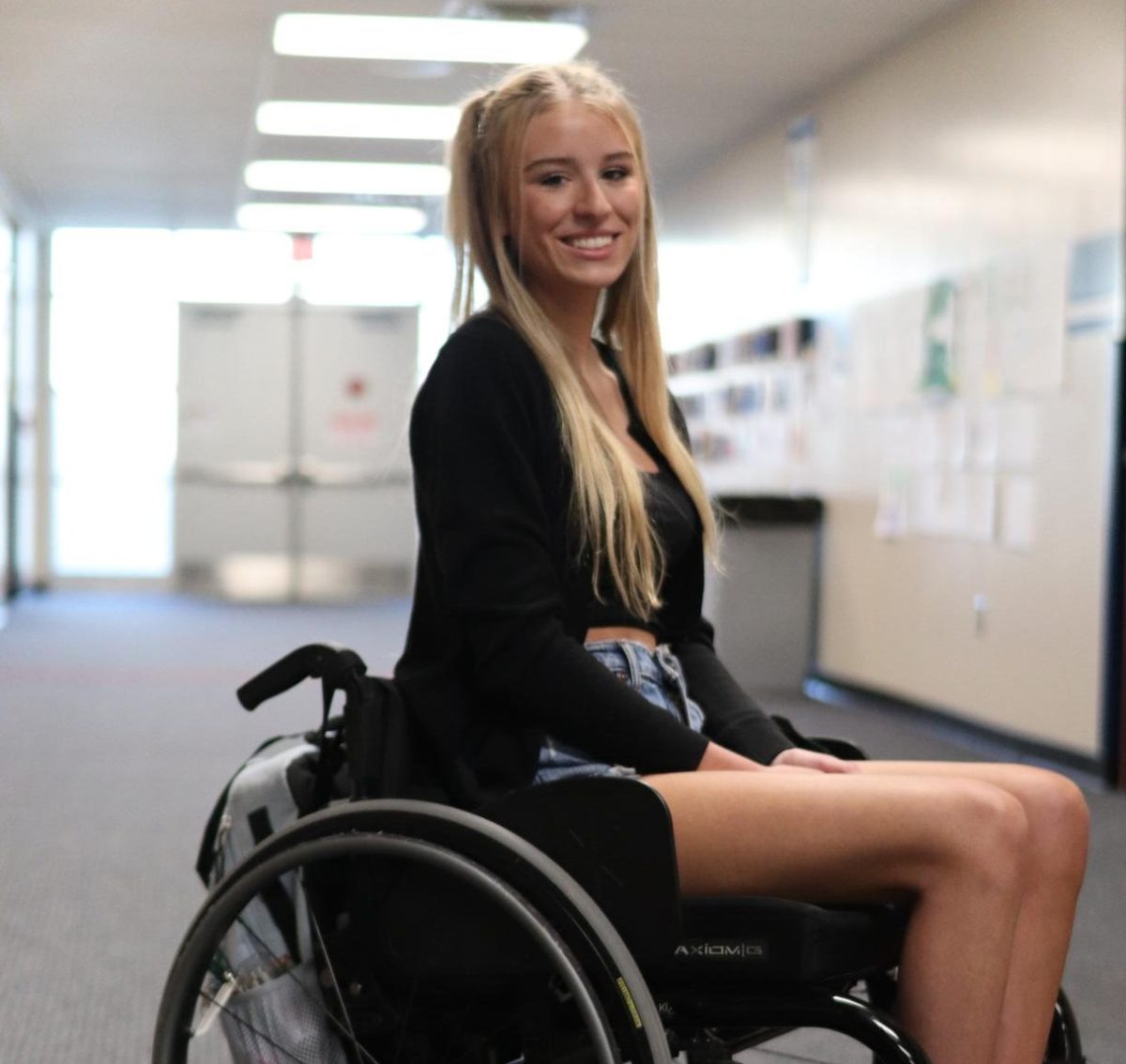
Staring at the door, Monet Neaton (12) patiently watched and waited. It was Aug. 20, the day she began her engineering program—five days before her first day of senior year at ELHS. She already had the jitters.
With each passing minute, unfamiliar faces filled the seats around her—one by one.
Simultaneously, her hope slipped further from her grasp.
The clock hit 11:35 am. As the final student arrived, the door clicked shut.
Out of 24 students, Neaton was the only girl.
“It was really awkward at first,” Neaton said. “No [other girls] ever came in.”
This is Neaton’s first year in the program at the Wilson Talent Center (WTC). According to the center’s website, the course “gives students hands-on experience with skills that are used by engineers,” specifically for beginners.
Since the first day, Neaton has found her groove. Though she is the only girl in her class, Neaton feels that her work and mindset aren’t impacted.
“I don’t really get treated differently,” Neaton said.
While so far, the class has mainly been focused on the basics, Neaton has also gotten to engage with various projects involving woodworking and wire cutting.

“I really like the hands-on aspect and the problem-solving stuff,” Neaton said. “It’s really interesting.”
Neaton’s instructors are especially encouraging and accommodating toward her. When the tools were too big and made for larger hands, Neaton remembers her teacher chiding himself to get smaller tools. Little interactions like these take place on the daily.
“The main [instructor] is always like, ‘I’m really happy you came, I try to get more diversity in here,’” Neaton said. “He’s always happy that I’m there.”
The instructors also support students in specialized workforce opportunities, such as job shadows. Neaton intends to pursue a job shadow in December, whether it be through the WTC or on her own.
“They want to help get people started early,” Neaton said. “You just have to ask and they’ll help.”
After she graduates, Neaton hopes to channel the skills she learned in the program toward an environmental engineering profession.
But most of all, she has one desire:
To help people.
This want is inspired by her mom, who Neaton recalls always being a helping hand.
“Our babysitter was having troubles and [my mom] happened to be at the gas station at the same time,” Neaton said. “[My mom] took her home and helped her out because her car wasn’t working. She then went back and fixed it.”
Neaton wants to be the same presence for people.
“I’m the same way,” Neaton said. “This class is something that will help me towards that goal.”
Though Neaton isn’t worried about going into a field dominated by men, her grandpa, her primary guardian, has some concerns.
“He says I need to be careful with it,” Neaton said. “He says, ‘you want to try to be safe, though, because you don’t know who they are [going to be].’”
However, he knows Neaton is passionate about engineering and wants the best for her in the field.
“He really likes the idea [of me going into engineering],” Neaton said. “He’s excited to see how it goes and he said he’ll support whatever I want to do.”
Neaton is aware of the benefits she could experience going into the field. According to the U.S. Bureau of Labor Statistics, one in three engineering roles go unfilled every year. This, combined with the large diversity gap, makes the industry a lucrative field to enter.
“There’s a really high success rate of getting into [engineering] because they really want more women to join,” Neaton said. “Of course you have to know the stuff, but it should be relatively easy [to get into the field.]”
There’s no room for clumsiness in welding.
A shake of the hand can be catastrophic.
One misstep and the whole project is destroyed.
Not everyone’s cut out for it.
But women like Alaina Switzer (12) already have an edge.
“Women are better at this field than men because we’re more coordinated,” Switzer said. “It’s harder for guys to render what they’re doing.”
As found by the National Library of Medicine (NIH), “women have superior hand stability compared with men at low force levels”—1.3 times as much.
Switzer intends to make use of this.
“It is very important to have good hand-eye coordination along with patience,” Switzer said. “In order to get the perfect weld, it must pass a visual test and a break test.”

As a second-year student at the WTC, Switzer takes to the lab daily, completing individual and group projects, such as a fully metal water fountain. Projects like these require careful planning and blueprints in order to be successful.
“There were three of us and we split up the project,” Switzer said. “I was the one who built the base and made the shape as well as the blueprints.”
Such assignments have helped her work toward a total of over 600 hours of class time needed to fulfill the WTC’s requirement. To complete this, the class is broken up into mods, which are a series of lessons.
But to Switzer and her classmates, these aren’t just classwork—they’re a race.
“We become competitive towards each other to see who will finish the weld and pass the mod the fastest as a bit of encouragement to become better welders,” Switzer said. “It’s the only time I have felt the need to prove my welding skills.”
Even with the presence of these playful rivalries, Switzer never feels out of place in her class.
“We’re not getting in each other’s way,” Switzer said. “I love welding because of the family it has given me along with all the achievements I have been able to accomplish.”
However, the work doesn’t come without its obstacles. Outside the classroom, Switzer has run into male welders who haven’t respected her or her work.
“The most frustrating thing is being a woman who is often looked down upon, not by my classmates, but by other guys who we meet at competitions,” Switzer said.
Switzer has pushed past such viewpoints to continue her path with welding. After graduating, she hopes to apply her skills in pipework or on army tanks. No matter where she ends up, Switzer is confident of the success she can have in the field.
“What inspires me the most is how much people don’t know about welding and how I can teach others more now that I know,” Switzer said. “Many think that [you] become a welder because you aren’t able to pass in school or get a degree in college — it’s the complete opposite. We do hard work and way more math than I have ever done in any class.”
When Mya Gonzalez (11) saw that the WTC offered a criminal justice and law class, she knew it was perfect for her. Gonzalez always wanted to be a police officer, and after watching her older sister Ava Gonzalez (‘25) graduate from the WTC, this opportunity seemed meant to be.
While this field is male dominated, it has not made Mya any less persistent in pursuing this career path.
“I really wanted to be a police officer, and when I saw that the Wilson Talent Center had criminal justice and law, I was really excited,” Mya said. “I went in for the 10th grade visit and just saw how welcoming the community was, and I knew this is what I wanted to do.”
Her days in class consist of learning about routine traffic stops and codes, practicing pressure point techniques and completing conditioning exercises. Through partner work designed to simulate real-life situations, Mya often faces challenges because of her height compared to her classmates.
“I’ve had a lot of problems with my height so far,” Mya said. “Because I’m doing a lot of things with other people, and most of the kids in my class are very tall it definitely causes a bit of a problem I have to work around.”
While her height might be a roadblock in class, her instructor tries his hardest to limit this impact as much as possible.

“My instructor tries to make sure that everybody feels included, and he makes sure that people are challenged, but not to the point where they can’t succeed,” said Mya. “There’s obviously going to be struggles out in real life that I’m going to have to face but right now, I feel like everything is going great.”
Having a very welcoming and accommodating instructor in the classroom is great, but the field is anything but accommodating, especially for female officers.
When Mya went on a ride-along with a female officer, she witnessed firsthand how much more difficult the field can be for women. After attempting an arrest, the officer had to call for backup, not because she couldn’t handle the situation, but because the suspect refused to obey a woman in uniform.
“While female officers generally get respect from their fellow officers, they definitely are treated more negatively by civilians,” Mya said.
The challenges women face in law enforcement aren’t limited to the field — Mya experiences them firsthand in people’s reactions to her career choice.
“Everyone seems kind of shocked,” Mya said. “I’m not sure if people seem shocked because I look nonthreatening or because I’m a woman, but they definitely don’t expect it.”
While people don’t always seem enthusiastic about Mya being a cop, it doesn’t make her any less excited. She takes pride in representing women in a male-dominated field and hopes her example encourages others to do the same.
“I’ve noticed so many more female officers and I think that if you want to see change, you have to be the change yourself,” Mya said.
When Taylor Martin (12) walks into her Cybersecurity class at WTC, she sits down and begins her daily work, which consists of breaking into and fixing computers. As she looks from left to right, desk to desk, she is met with the faces of 35 boys and only five girls. As Martin plans to become a cybersecurity data analyst, the reality of being one of the few girls in the workplace is something she cannot avoid.
“My freshman year I took a class with Mr. Mayes on coding video games, and it just came so easily that I was coding multiple games at a time,” Martin said. “That’s when I knew this was something that I really wanted to go into.”
Through the WTC program, Martin is in early middle college, meaning that she’ll have an extra year of school before college. In this time, she’ll earn her associates degree in only one year instead of two, which is being paid for by the state.
“I’m already in seven college classes,” Martin said. “[On] my Powerschool, I have to scroll down for a couple seconds because I have so many classes [that] I’m taking right now.”

As much as Martin loves her field, women only make up around 25% of the world’s cybersecurity workforce, and the lack of female representation is definitely a downside she has had to come to terms with.
“When we go on field trips for the class there’s usually one female speaker, and it makes it very awkward when there’s seven male speakers,” Martin said. “When we went to visit the state police, I didn’t think I saw a woman working except for the receptionists. It’s very disheartening.”
While Martin is met with respect from some of her male counterparts, she also faces snarky remarks and comments from others.
“I told my classmates and my instructor that I was being interviewed about going into a male dominated field,” Martin said. “One of my male classmates was upset that he wasn’t interviewed along with me and proceeded to say he was confused as to why I was getting interviewed and not him because he was more skilled.”
When Martin expresses her interest in cybersecurity to adults, she is met with shocked faces and a tone of uncertainty.
“They almost seem like they don’t know how to respond,” said Martin. “Women usually ask me questions and are confused as to why I want to go into this field while men seem more taken back by the idea.”
Sarcastic and snide remarks are just one of the challenges that Martin has faced and expects to face in her near future.
“The dress code for the females is drastically longer than the dress code for males,” said Martin. “We can’t wear jeans, leggings, skirts or shorts. So finding an outfit has been a pretty time consuming roadblock.”