

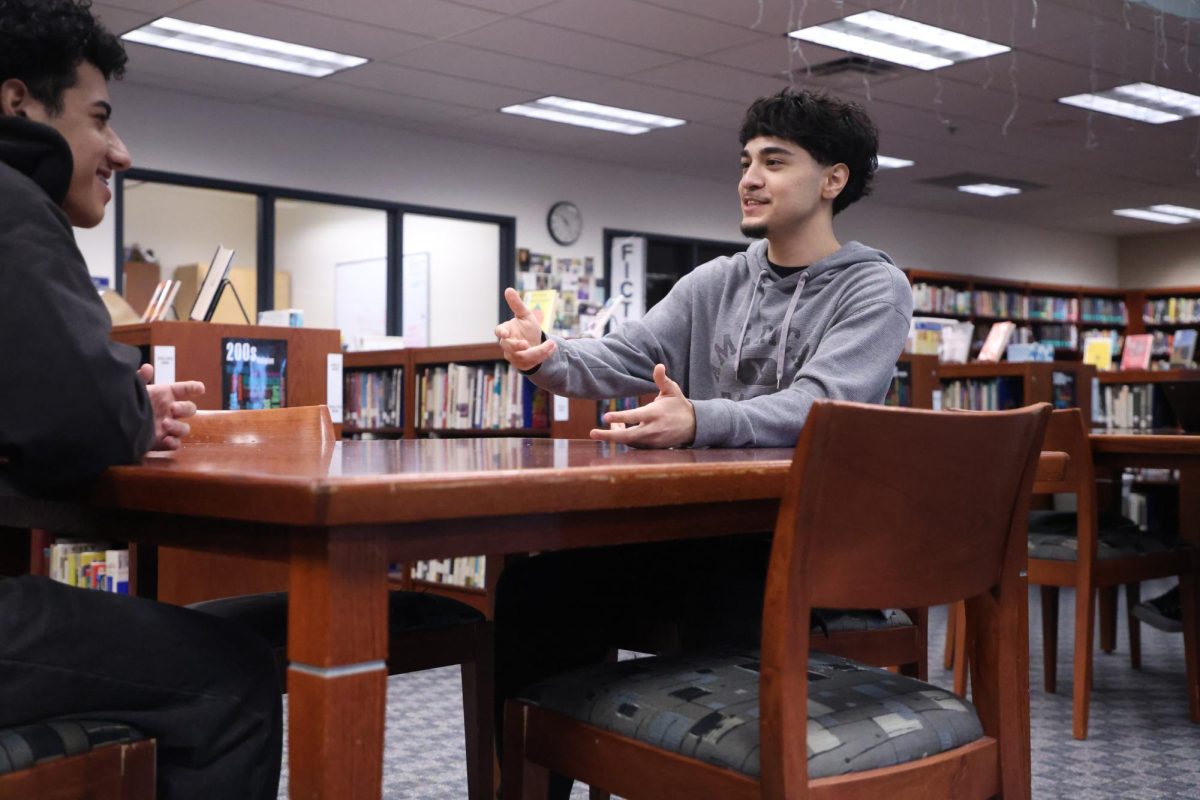
The need to learn a new language was the last thing Saad Almora (12) was prepared for at age 6. After being forced to flee Iraq due to the civil war against ISIS, Almora and his family found themselves in Iraq, an Arabic-speaking nation. The stress of immigration was compounded by the immediate, overwhelming necessity of communicating. For a child who had just started school a year prior, the challenge wasn’t just academic–it was emotional, cultural and deeply personal.
“The war was bad,” Almora said. “We had to flee when we realized how bad it actually was.”
For many students, learning a second language happens gradually—through classes, apps or casual practice. For Almora, it was survival. The moment he and his family arrived in Iraq, the language barrier stood between him and his ability to communicate, understand and feel safe. He remembered how even a simple task, like asking for directions or understanding what neighbors were saying, was nearly impossible.
‘’When I would hear people talk, I wouldn’t know what they were saying because everybody in the country spoke Arabic,’’ Almora said. “Thats when I realized I had to take it seriously.”
The transition wasn’t easy. Almora remembers the culture shock, the stress of displacement and the urgency of adjusting to a new world far different from the one he knew. Nearly everything–from the food to the daily routines–felt foreign and the unfamiliarity only added to the stress of leaving home so suddenly.
‘’It affected a lot of things,” Almora said. “But the hardest thing was learning a whole other language.”
The process of learning Arabic took years of work. At first Almora heavily relied on gestures, context clues and the help of relatives who already knew the language. Over time those small moments of practice built his foundation. He recalled how intimidating it felt to make mistakes, especially in front of native speakers, but he kept trying.
‘’It took me three years of learning and speaking with family just to feel adjusted to the language,” Almora said.
Almora found the process of learning Arabic exceptionally difficult because the language is much more complex than English. For him, the structure and pronunciation of the language was the most challenging to master.
“It’s a lot harder than anyone would think,” Almora said. “There’s pronunciation that you would never hear in English. The vocabulary is staggering and there’s five times more words than in English.”
Despite the persistent danger due to war, Almora remembers how his family would focus on meeting daily needs and maintaining a sense of community.
“During [the] war we would wake up, get food and water, then my family would come back and support the family,” Almora said.
Almora recalled moments when everyone stayed strong together–times that felt almost like normal childhood memories despite the conflict around them. These moments were what helped him stay grounded, reminding him that even in difficult circumstances, people still found ways to connect, laugh and hold onto hope.
“Honestly, it was fun at times,” Almora said. “We’d be chilling, grilling and little things like that.”
Those small traditions and activities became a source of comfort, giving Almora faith that life could still be joyful, even if everything around him was changing.
“I pretty much have it all down and am very confident [in the language],” Almora said.
The fluency he achieved through years of struggle has provided a lasting gift that extends beyond simple conversation. He believes knowing the language fluently has helped him immensely, including communicating with relatives, and gives him better opportunities. What once felt like an overwhelming barrier has become one of the strengths he values most in his identity.
“Learning Arabic didn’t just help me survive–it helped me understand who I am,” Almora said. “Now it’s a part of me I don’t want to lose.”