

Mark Foster remembers it like it was yesterday.
It was 2000, and he was the head track coach at Vicksburg High School, just south of Kalamazoo. It was the meet against their rivals, and it was tied down to the last event: the 4 x 400.
Like a rocket, Vicksburg’s runner flew off the block and sped down the track. As the rival team began to pull ahead, Foster worried that their runner had gone out too fast. Students lined the field to watch as they headed towards the straightaway, behind by just five meters. Closer and closer to the finish, Vicksburg started to gain. The student section went crazy, whooping and cheering. Vicksburg’s runner crossed the finish line just one step ahead of the rival runner.
The stadium erupted in celebration. Athletes went berserk, high fiving, hugging, and congratulating each other. Foster stood in the middle of the mayhem, but he wasn’t celebrating.
He wasn’t doing anything.
He just stood there, wanting nothing more than to get out of that place and go to bed.
No elevated heart rate.
Nothing.
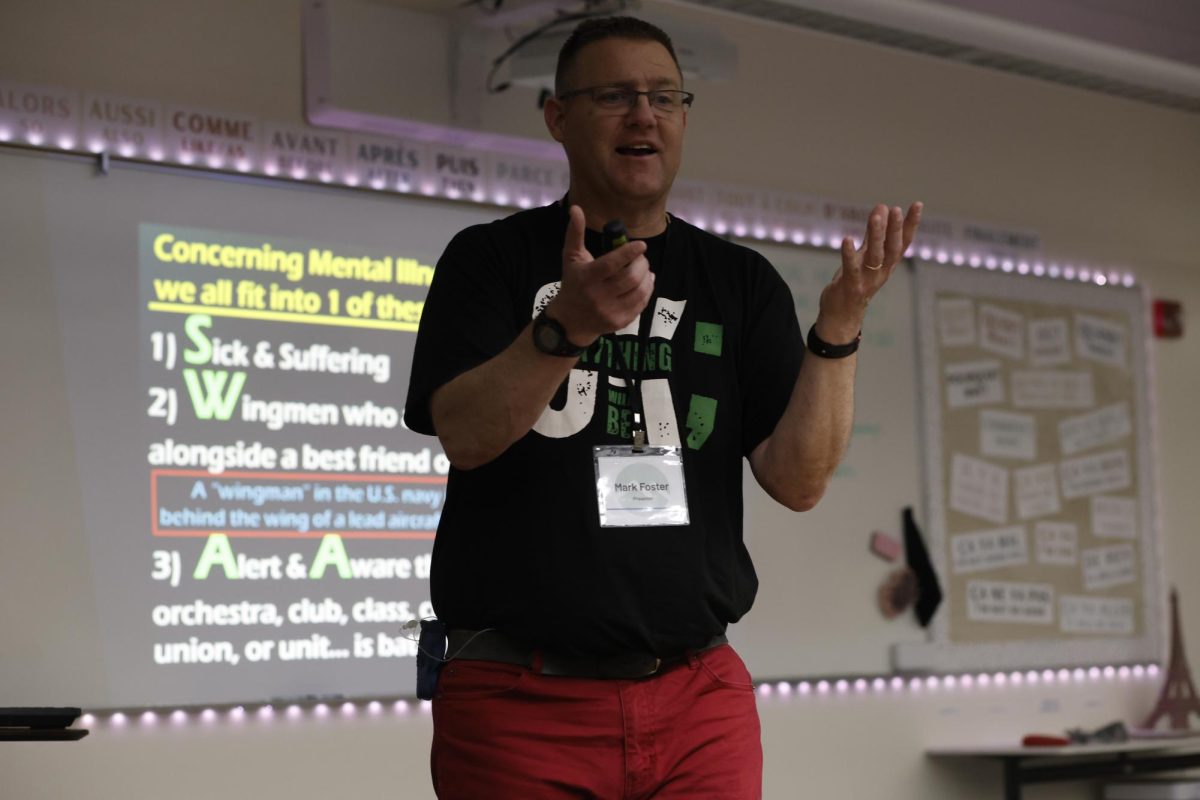
This was the story Foster told a group of around 30 people in Excel as part of the Mental Health Summit on April 28, and later a smaller group at the summit on April 29.
While telling it, he wanted his audience right there with him on that track. He wanted them to understand what it was like to live with depression.
“I told a school administrator, ‘I’m not alive. I’m breathing, but I’m not alive,” Foster said at the summit.
This was how he lived for five years, fighting the most difficult battle of his life without any emotion.
During the presentation, Foster recalled being prescribed dozens of medications that had all eventually stopped working. His psychiatrist found himself running out of treatment possibilities. Finally, after years of trying, they found something that they thought worked: transcranial magnetic stimulation. Every day for six straight weeks, he was treated by a specialized electromagnetic coil that delivered repetitive pulses to his scalp. Each day, he got better.
Foster felt wonderful, like he hadn’t for years. It finally seemed like the weight of depression had been lifted.
But then it started again. First as a trickle, before it worsened immensely. He tried to push it away, masking his symptoms. He didn’t want anyone to know, because he didn’t want to let them down. But in the fall of 2016, he decided to go get help.
Now, Foster has an EMSAM patch, which has worked for nine years.
This was Foster’s third year speaking at the Mental Health Summit. Although it’s a hard story to tell, he feels it’s an important one.
“I could feel my voice shaking, especially during certain parts of the presentation that were really emotional and personal to share,” Foster said later. “It’s a hard thing to do, but if you convince yourself it’s important and impactful, that trumps your nervousness about the situation.”
While only around 15 people attended his talk the first couple times, the amount of positive feedback he got for his presentation told him that what he had to say was significant.
“I went in [thinking] if I can help just one person, it’s worth it,” Foster said. “I realized the impact was greater than just one person.”
When Margaux LaLande (10) had walked into the cafeteria during Excel to watch the presentation, she’d expected it to be boring. But Foster’s vulnerability surprised her.
“Overall, I feel like it was definitely impactful hearing real people’s stories,” LaLande said. “I didn’t know that about Mr. Foster and I just thought it was brave of him to put himself out there after all that happened.”
Because of this feedback, Foster has continued to tell his story and he plans to give this presentation again next year. He thinks that talking about mental health more is the first step to making an impact.
“There’s still [a] stigma that exists with mental health,” Foster said. “Some people view it as a weakness. I think the more voices that are heard, the more comfortable others [will] be about sharing that they’re having difficulties.”