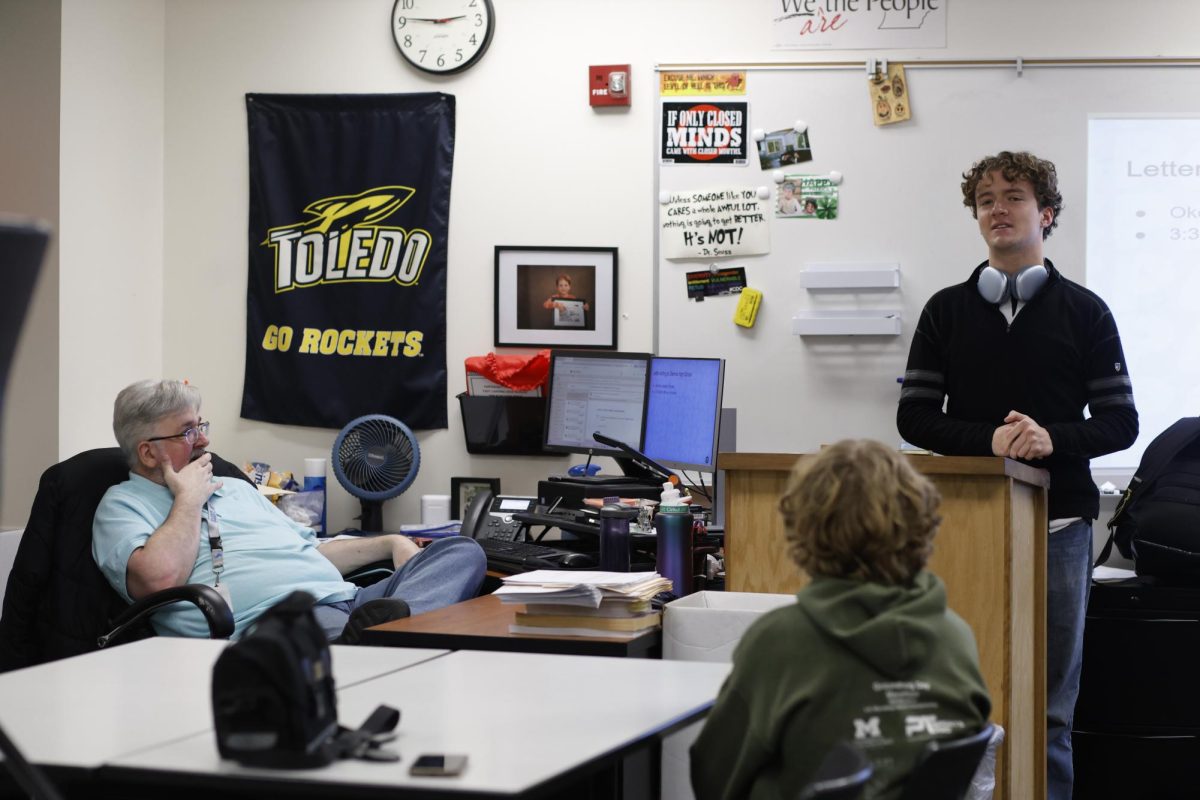




It was early morning, before school had started, when Students for Political Action (SPA) club president Quinn LaFaive (12) walked into SPA advisor Timothy Akers’ classroom to talk with him. They chatted casually for a few minutes, and LaFaive was ready to leave when Akers remembered something. He thought LaFaive “deserved to know” about a paper he had recently received, so he pulled it out to show him. When LaFaive read it, he was shocked.
It was a Freedom of Information Act (FOIA) request sent to the school by the campaign of U.S. Representative Tom Barrett.
“The request wanted all of the email correspondence between any staff in the building and the students regarding the ICE walkout,” Akers said. “As well as between the staff and [William] Lawrence, a former student of mine who is now running in the Democratic primary to run against Barrett.”
After he’d read it, LaFaive took a photo of the request and sent it to the club’s group chat. Members were stunned that their protest was getting this kind of attention.
“I was really surprised,” LaFaive said. “I had never heard of a high school being FOIA’d for a walkout. It was shocking.”
Despite the initial astonishment, club members moved on from discussing the request rather quickly.“Obviously it’s cool because it means that we’re getting to him and he’s listening to us, but it doesn’t change what we’re trying to do,” LaFaive said.
In order to comply with the request, LaFaive’s personal emails with Akers had to be shared with Barrett’s staff.

Yet, he wasn’t angry.
“I wanted something from Barrett, some reaction,” LaFaive said. “So I guess I kind of got what I was asking for.”
He believes that things like this come with the territory of doing public protests.
“I can’t be mad about it,” LaFaive said. “But it was definitely surprising that a current Congressman would like to read a high schooler’s email.”
SPA member Miles Johnston (12) was sitting in Akers’ fifth hour Film as Literature class when he was called over by Akers, who showed him the FOIA request.
He was confused at first, not quite sure what it was. Once he understood, he felt similar to LaFaive.
“I thought it was cool, honestly,” Johnston said. “Because we got the attention of our representative.”
However, the more Johnston thought about it, he was simply annoyed with the Barrett campaign.
“If you’re spending your time and resources going after high schoolers speaking out against a murder in the streets, you’re kind of a joke,” Johnston said. “It dwindled my opinion of him even more.”
While the request surprised SPA members, Jason Cabel Roe, press secretary for the Barrett campaign, noted that this FOIA was a routine request.
“The purpose of the FOIA was to find out what, if any, role Democratic candidate William Lawrence played in the planning of the walkout,” Roe said.
Despite this, it is still very uncommon for a congressional campaign to FOIA a high school club.
“Everyone has a right to know what business is conducted within a school,” Akers said. “But very rarely is it exercised against [a] student club. Usually it’s about things done [at] an administrative level.”
Akers sent the FOIA request to Lawrence so that he could be made aware of it, and Lawrence laughed when he saw it.
“It was the SPA group taking leadership, and I was happy to support them,” Lawrence said. “I thought it was funny that Barrett would expect that there was some conspiracy happening there.”
Barrett represents Michigan’s 7th Congressional District, which includes East Lansing. According to The Cook Political Report, the 2026 race for his seat is one of only 18 in the entire country that is a complete “toss up,” meaning there is a fifty-fifty chance for it to go either Democrat or Republican.
It’s one of the most competitive 2026 election races, as stated by 270toWin.
Although Barrett is in an aggressive race, SPA members believe his campaign should focus on more important things than school clubs.
“If you’re FOIAing high schoolers, you can do a little bit more in Washington aside from that,” Johnston said.
Lawrence agrees, and he hopes that things like this won’t discourage students from getting involved.
“I think young people have a very clear sense of right and wrong and a strong moral compass,” Lawrence said. “Really it only needs a few people to make a strong statement, so a few friends can get a lot done together. One person telling the truth and having courage tends to inspire other people.”