
86 days.
86 days of partisan squabbling and indecision.
86 days past the deadline.
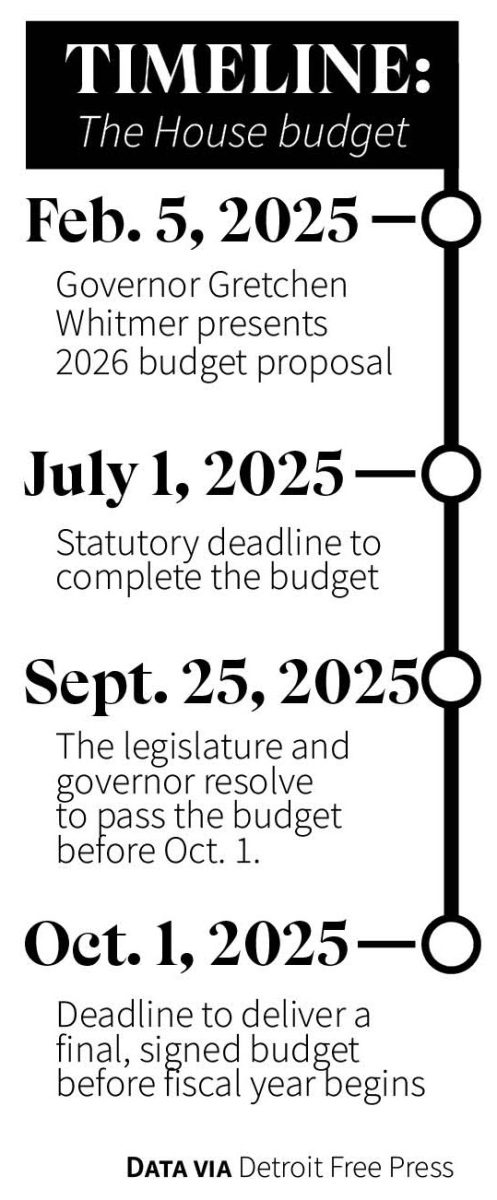
On Sep. 25, the Michigan House finally passed Bill 496, laying the framework for the 2026 fiscal year state budget. The bipartisan 95 to 4 vote came just days before the Oct. 1 final deadline to pass a state budget, narrowly avoiding a government shutdown.
While Michigan lawmakers may pat themselves on the back for finally passing it, the truth is simple: this budget is too little, too late, especially for Michigan’s schools.
The risk of a government shutdown isn’t just theoretical. It would have meant the closure of state parks, halted road construction and temporary layoffs for thousands of government employees. But most alarmingly, it would have resulted in schools across the state–including East Lansing Public Schools–missing their first state aid payment, scheduled for Oct. 20.
On Sep. 10, superintendents in the Ingham County Intermediate School District–including East Lansing Superintendent Dori Leyko–sent out an email to guardians, urging them to call local representatives and demand action.
“[This] payment is a major resource we rely on to compensate teachers and staff who work directly with students; maintain class sizes and student support services; maintain bus operations; fund academic programs, arts, athletics and student activities,” Leyko said in the email.
With no state budget approved going into the 2025-2026 school year, many school administrators were left grasping at straws on how to plan for the school year. Some districts, like Okemos, decided to cut free school breakfast and lunch altogether, while East Lansing decided to wait until Sept. 30 to make a decision. Although a budget was not passed before the deadline, district officials have made it clear that school breakfast and lunch will remain free for all East Lansing students.
Mere days before the budget was tentatively approved, Assistant Principal Jeffrey Lampi expressed concern about the state government’s inability to sign the budget bill.
“It’s very disappointing that we have not put one of the pillars of our society, public education, and the needs of students first, along with thousands of wonderful teachers who sacrifice and dedicate their lives to public service,” Lampi said. “We have to do better at the legislative level.”
The budget framework certainly contains some positives for schools. It renews funding for the Michigan School Meals Program, which was expanded last year to provide free school lunches to all K-12 students, regardless of income.
But other district needs were simply ignored. Despite a deepening teacher shortage, the budget offers no new funding for recruitment or retention. Investment in school infrastructure, mental health resources and student transportation–all issues schools have flagged for years–remain almost nonexistent in the outline.
For a bill that touts increasing government efficiency, the wasted time that stretched on before the ultimate passing of the bill is simply unacceptable.
With people nationwide bracing for the impacts of a federal government shutdown, the looming threat of a double shutdown is still very real.
And this fight certainly isn’t over. As of Oct. 1, the Michigan Senate has yet to approve the bill, and Governor Gretchen Whitmer has not signed it, though the governor has promised that a shutdown will not occur. Michigan and Pennsylvania remain the only two states without a finalized 2026 budget.
The budget was introduced in early February. Lawmakers had until July 1 to get it done. Instead, it took 232 days to reach a compromise.
That’s not governing, it’s negligence.
The Michigan legislators need to set a higher standard–for our schools, for our citizens and for our future.