

You may be familiar with the story of “Frankenstein.” A dark and stormy night. A mad scientist, eyes aflame with insanity. A giant green beast, arisen from the bodies of the deceased.
Even though this story only exists in the pages of Mary Shelly’s novel, computer scientists have taken on the role of Frankenstein—creating their own powerful monster.
It’s something more powerful than ourselves.
Something that inspires both fear and awe.
Something more intelligent than the smartest human, and faster than the sharpest person.
A force that can give us answers at our fingertips or make anything our heart desires.
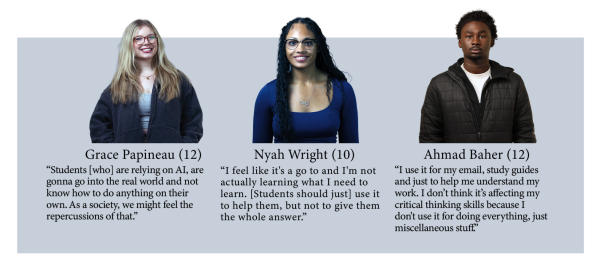
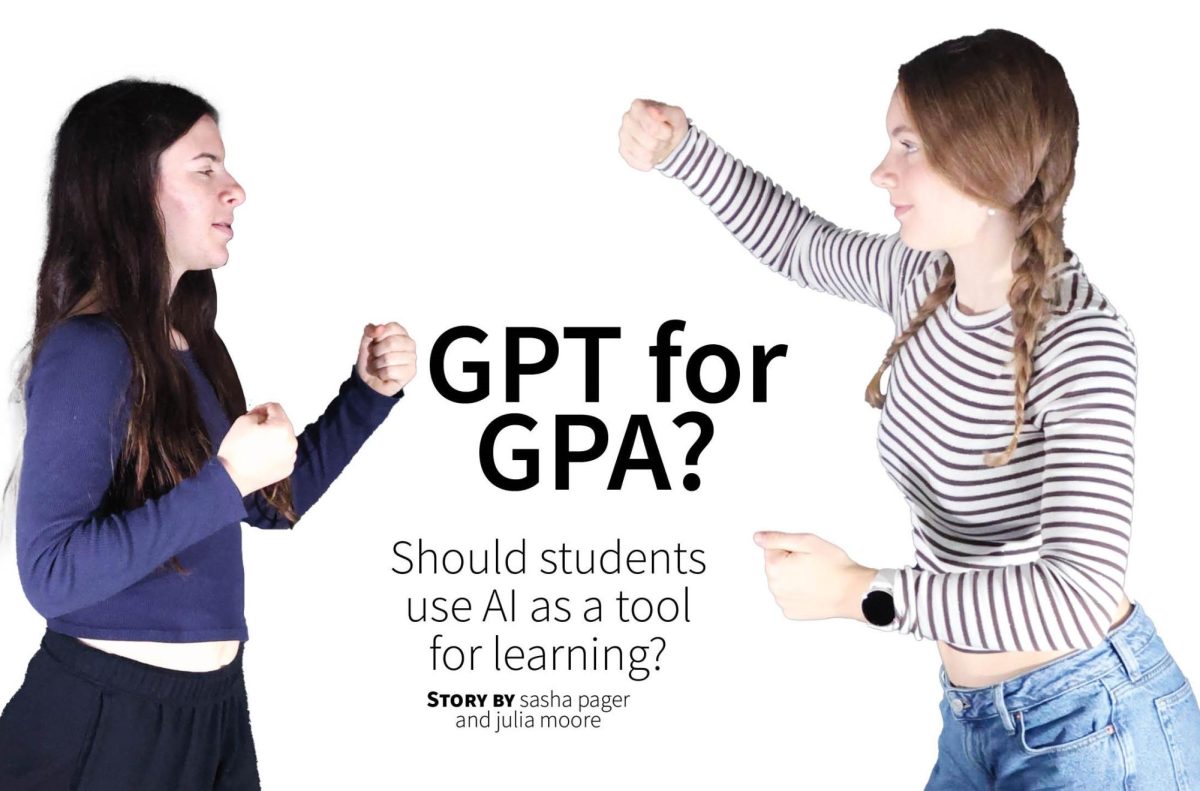
Whether we like it or not, that being—AI—is here to stay. But what does using AI, specifically for school, mean? Is it an efficient tool, or is it destroying our ability to think for ourselves?
Con: Story by Sasha Pager
AI is a slippery slope. You use it once to ask a simple question, and then suddenly, you can’t stop. The fact is, it’s inherently made to be this addicting—simple responses at your fingertips.
When I make Google searches, my eyes are immediately drawn to the large AI overview at the top. As much as I try to avoid it, I can’t help but look at that nice, amplified text at the top of the page, giving me an immediate answer to all of my questions. I don’t even bother questioning its validity. The thing is, this just leads us to giving in too easily. We don’t stop and think—we just ask AI for the answer.
AI shouldn’t be used in the classroom because it harms student’s critical thinking skills. If you sit idly by and let AI spoon feed you information, you won’t be actively problem solving. And when learning new ideas, the process of figuring out a concept is just as important, if not more important, than the actual knowledge itself.
Problem solving is a skill that will help students in school. According to an article from the University of Michigan, “solved problems involve more elaborate processing and spreading activation due to comprehension and answer generation, allowing for easier retrieval.” In other words, when students use problem solving to figure out how to solve a problem, instead of being shown how to do it by a teacher, they are more likely to remember how to solve that problem on a test.
Problem solving is not only a skill that will help students in school, but a skill that will aid students in the future. This is because the problem solving process that comes with learning new things teaches you valuable thinking skills that can be applied to many other instances in life. For example, learning how to use the Pythagorean theorem may not help you in your future career, but the ability to problem solve that you gain from figuring out the theorem is a skill that will benefit you for the rest of your life, no matter what you’re doing. However, students won’t be able to develop these problem solving skills if they are relying on AI to supply them the answers.
There’s no doubt that AI can make things more efficient. But as high schoolers with growing brains, we shouldn’t be relying on AI so heavily because it may disrupt our critical thinking skills before we even have the chance to develop them.
Pro: Story by Julia Moore
“How little can I study to still get an A?”
“How many extracurriculars can I fit into a 24 hour day?”
“How many AP classes can I take in a year?”
As college becomes harder to get in to and increased social media use leads to increased comparison, the pressure placed on students–to excel in school, sports and more–is piling up. In our hyper competitive world, AI can be a useful tool in helping us with assignments and tests, allowing us to take harder classes without overworking ourselves to the bone.
Even though the use of AI in school has the potential to decrease cognitive functioning for its users, the increased efficiency allowed by AI outweighs the negatives, and should be used by students to some extent.
AI allows for individualized learning and feedback for its users. When I was struggling through AP Calculus AB, using AI-powered math apps helped me understand questions on my homework that I had no idea how to tackle. They guided me step-by-step through the difficult equations and helped me not fail the class.
I know that I’m not alone in using AI to help me get individualized learning. Many programs, such as Khan Academy and McGraw Hill, use AI, which allows them to give their users direct guidance based on their performance. This is especially helpful for kids who may differ drastically in their learning capabilities, such as those with disabilities or whom English isn’t a first language. According to the American Psychological Association, “These AI- powered systems promise to help personalize the learning experience for each student, tailoring style, pace, and assessment to the individual.”
AI can also be a helpful instrument when studying for tests, especially ones where the curriculum is standardized across the country, like AP or the SAT. AI can make flashcards for you, give you practice problems, and reorganize your notes. One time, I had AI explain psychology concepts in terms of Gossip Girl characters, allowing me to better understand and retain the information. These devices make studying much easier and less stressful.
There is a lot of fear among people about the use of AI– it is ruining our thinking abilities and cognitive functioning. But as long as AI is used appropriately and doesn’t supplement problem solving when learning new skills, it is a powerful tool that can allow us to learn more information faster, and makes the learning process much more equitable for students. Instead of cowering in the face of the inevitable advancements of AI, we should be learning how to use it appropriately, thus “befriending the monster.”