

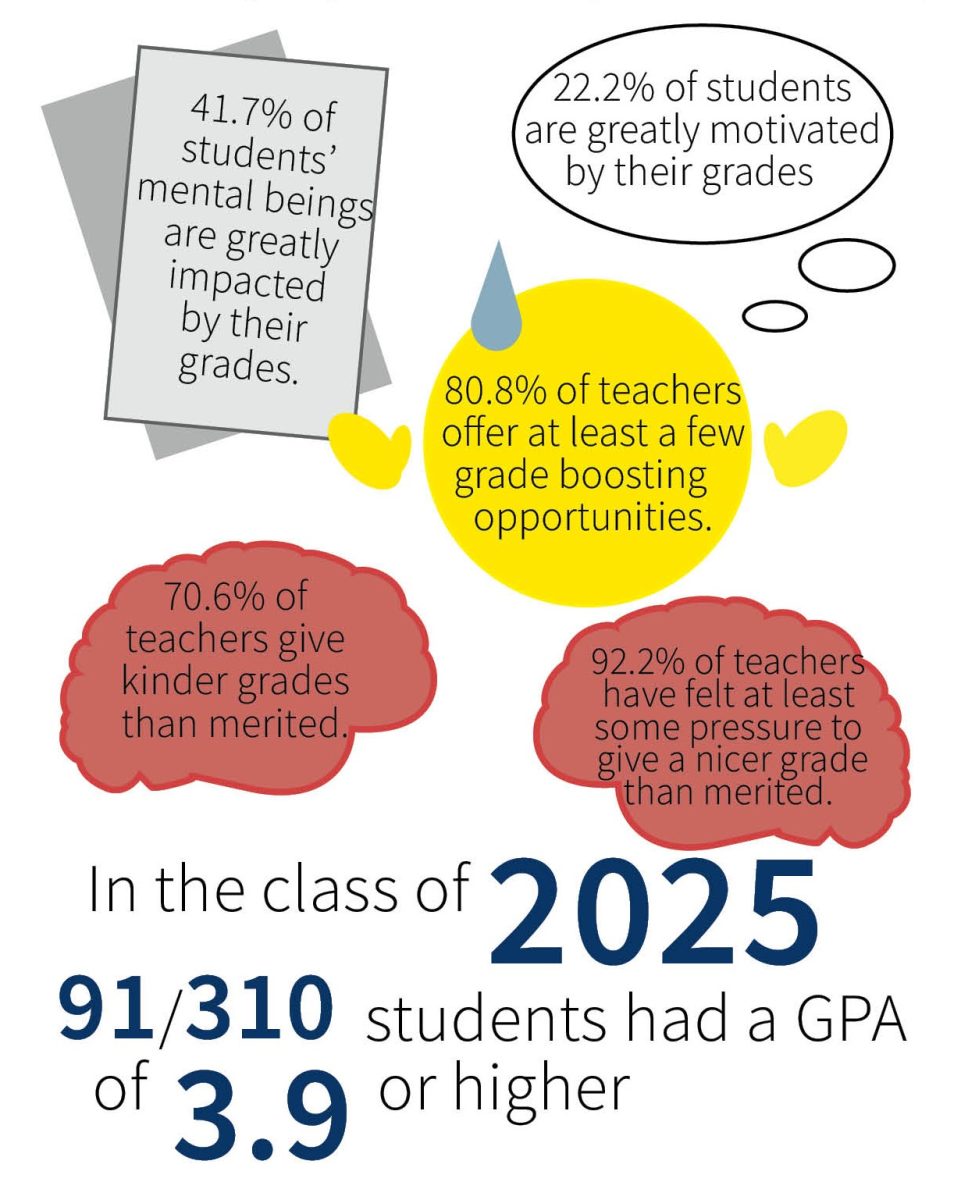
If you’re reading this, you’re likely a part of the 30 percent of students who will graduate with a 3.9 or higher. You almost had all As, a few frustrating A-minuses from that biology class tainting your perfect record.
You’ve worked hard—or maybe just added an extra hour every time you logged an event—to get 90 hours in NHS. After all, you’ll get another cord to add to your stack of 10.
You’ve paid for and taken all six of your AP tests, passing five with flying colors. You proudly claim to be an AP Scholar with Distinction. You have taken every possible route to successfully prepare for the next stage of life.
Congratulations. You’re not special.
We are all just a cog in the system of the antiquated, overinflated letter grading system, initially developed to more efficiently measure our scope of intelligence. A structure that emerged during a time when we sent masses of students to work on assembly lines. And yet, we continue to rely on it in a time dictated by virtual clouds of information, not smoke-filled ones of the Industrial Revolution.
It’s clear that our school wants the very best for us. They want us to have big, individual dreams—ones that are followed and achieved. But they need to pop the inflated grading system in order for us to actually see them through.
We’ve been slighted by the improper use of six simple letters. If an A is meant to represent complete understanding and application of a concept and an E is the utter lack thereof, all the other letters should measure the space in between—an expanse where the vast majority of us should be. Otherwise, we should all be examined for our genius. But, as one surveyed teacher described, our grade distribution tends to look like an “inverted bell curve:” far too many As for those who are grade motivated and a surplus of Es for those who aren’t.
Now, because of grade inflation, which is the awarding of higher grades for the same quality of work over time, an A is just as common as the dirt beneath our shoes. After polling teachers at ELHS, 42.3 percent of 26 respondents reported that the grades they give are, at best, only somewhat representative of their students’ actual understanding of class material.
By swelling Bs and Cs into As and A-pluses, we’ve created an incentive that will only come back to bite us. According to the National Library of Medicine, “128 studies showed that tangible rewards (e.g. grades, points, etc.) undermined intrinsic motivation across a variety of activities. When grades are introduced, the internal drive to engage in learning may be replaced with the desire to achieve the external reward.”
And while all other kinds of inflation are despised, grade inflation is something that’s largely encouraged by today’s society. Large sums of scholarship money are awarded to the students with GPAs higher than a 4.0 and As stacked in militant rows. Kids’ anxieties about going home to frustrated parents are eased when a flawless report card hits their inbox. And let’s not forget the endless amount of academic validation after seeing a 100 percent circled in bright pen on that test we got back.
So now all we feel the need to do is get yet another A. Once we do, we’ll discard the prior knowledge needed to make room for more—all to just get that gratifying PowerSchool notification again. We don’t care if we’re actually learning something. That isn’t the point. Grades are the only cycle we know.
Our teachers keep pumping these letters up more and more because they know just how much our mental state balances between an A and A-minus. Upon polling, 41.7 percent of ELHS students reported that their mental well-being is greatly impacted by their grades, while 38.5 percent of ELHS teachers noted their students feeling this way.
We’ve probably all heard our teachers discuss how they feel obligated to do all they can to make a student pass, even if they know that individual isn’t ready. How is this fair to both the teacher and the student? The teacher can’t actually perform their job; instead carrying out an idealistic version of it. The student will only face harder problems after high school, but this time, they won’t have a caring teacher to fall back on. Both receive the short end of the stick.
By subverting potential failures, we’re leaving out a normality of learning in itself. Learning is full of lows that are as equally large as the highs, allowing you to adapt and change. We shouldn’t just be getting As for the sake of how good that letter makes us feel.
So the collective mindset needs to change. Our “grades” should be based on our applied and literal understanding of what we’re consuming in day-to-day class periods. No more evading failure. No more playing the game. No more unwarranted points. It’s as simple as that.
Of course, this requires an immense amount of accountability on both sides. Teachers need to care about how they analyze their students and their capabilities, assessing them based on how they’re actually performing—not how they say they’re going to. Students have to put in the effort for themselves and can’t just rely on scapegoats. We have to care about the process, not the product.
By fighting the traditional use of the system, we’re supporting real future doctors, lawyers, entrepreneurs—not just wannabes. The real world only cares if you have the ability to apply your knowledge. It doesn’t give a crap about your transcript.